.png)
While Canada’s Biggest Markets Cool, Winnipeg Keeps Climbing
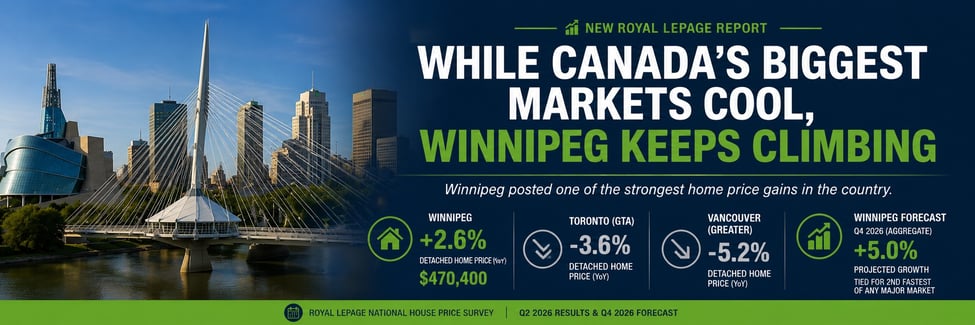
Royal LePage’s newest national report shows detached home prices falling in Toronto and Vancouver — while Winnipeg posted one of the strongest detached-home gains in the country.
If you’ve been watching the national headlines and assumed every Canadian market is cooling off the same way, the numbers coming out of Winnipeg tell a different story.
Quick Snapshot:
- National single family detached price: $862,400, down 0.9% year-over-year
- Winnipeg single family detached price: $470,400, up 2.6% year-over-year
- GTA detached: down 3.6% YoY | Greater Vancouver detached: down 5.2% YoY
- Royal LePage’s Q4 2026 forecast (aggregate) has Winnipeg growing another 5.0% — tied for the second-fastest projected growth of any major market in the country
The National Picture | Winnipeg’s Story | What the Forecast Says | For Buyers | For Sellers | FAQ
The National Picture: A Market Still Finding Its Footing
Every quarter, Royal LePage releases its National House Price Survey — a snapshot of home prices across more than 60 Canadian markets. The Q2 2026 numbers, released this week, tell a story most of the country already feels in the headlines: after a slow, cold start to the year, the national market is still working its way back to solid footing.
The national median price of a single-family detached home landed at $862,400 in the second quarter — down 0.9% from a year earlier, though up a modest 0.6% from the first quarter. Royal LePage President and CEO Phil Soper described it as a market where “what has kept consumers on the sidelines is not a lack of interest, but a lack of urgency.”
That hesitation shows up most clearly in Canada’s two biggest markets. Detached home prices in the Greater Toronto Area posted a 3.6% year-over-year decline. Greater Vancouver detached prices were down 5.2%. Both regions are still working through the kind of price correction Winnipeg’s detached market simply hasn’t seen.
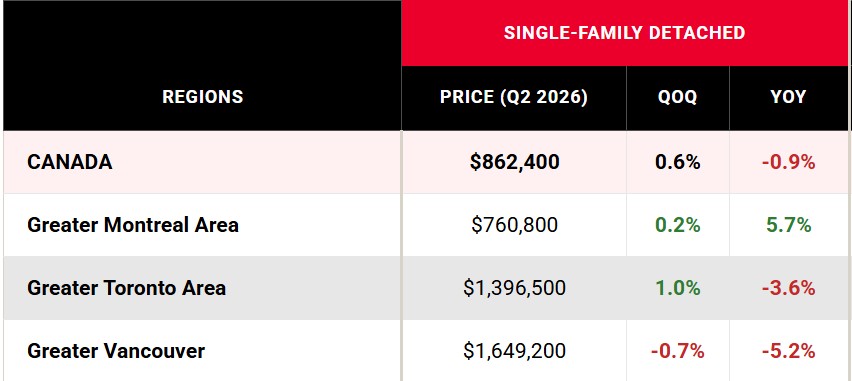 Royal LePage's Q2 2026 numbers show a mixed national picture. Here's where Winnipeg fits into it.
Winnipeg’s Story: Still Climbing
While the country’s priciest markets cool off, Winnipeg is doing the opposite. The median price of a single-family detached home here rose 2.6% year-over-year to $470,400 in the second quarter.
It sounds like a small number next to Toronto’s price tags, and that’s exactly the point. Winnipeg isn’t chasing headlines — it’s quietly compounding. According to Michael Froese, broker and manager at Royal LePage Prime Real Estate, “Winnipeg’s spring market performed largely as expected, with activity building steadily through May before beginning to level off in June, signalling the seasonal market peak. Despite lower sales volumes, home prices continued to post modest year-over-year gains due to limited inventory.”
That word — modest — is doing a lot of work here, and it’s worth sitting with. Winnipeg’s own board data backs it up: going back to 2020, the average Manitoba detached home price has climbed from roughly $310,000 to $431,000 — and in that stretch, there was really only one down year, in 2023, when higher interest rates cooled things off nationally. No boom, no bust. Just a market that keeps inching forward while bigger cities go through wilder swings.
Zoom out further and the pattern holds. Manitoba’s total real estate transaction value has grown from $858 million in 1988 to just over $6 billion in 2025 — through four recessions and a pandemic. Even during the 2008 financial crisis, when other markets saw prices collapse, dollar volume here kept climbing. That’s not a market that avoids downturns entirely — it’s one that tends to absorb them better than most.
Froese also flagged something worth watching: inventory has improved meaningfully since May, giving buyers more selection than they’ve had in a while, and changes to immigration policy are starting to influence investor behaviour in the rental and new-development space. Neither is a red flag on its own — but both are signals worth understanding if you’re planning a move in the next few months.
If you’re relocating here yourself, numbers like these only tell part of the story — download the guide to moving to Winnipeg covers what to know before you buy in a new city.
👉 Get New Listings Sent Directly to You
Sign up for MLS alerts so you're seeing new Winnipeg listings the moment they hit the market — not after the best ones are gone.
What the Forecast Says
Royal LePage doesn’t just report where prices have been — it forecasts where they’re headed. For the fourth quarter of 2026, the national aggregate price is projected to rise 2.0% year-over-year. Winnipeg’s forecast is more than double that: 5.0%, one of the highest projected gains of any major market Royal LePage tracks — tied with Greater Montreal and behind only Quebec City.
Compare that to where Toronto and Vancouver are headed. Both are forecast to keep declining into Q4 2026 — Toronto by 2.0%, Vancouver by 3.5%. It seems like the country’s most expensive markets and its most affordable ones are moving in opposite directions right now, and Winnipeg is squarely on the growing side of that split.
Worth noting: Royal LePage publishes its quarterly forecast as an aggregate figure across all housing types, not broken out by detached specifically the way this quarter’s actual numbers above are — but it’s still the clearest signal we have of where each of these markets is headed.
What This Means for Buyers
It sounds like now might be a good window — and for a lot of buyers, it genuinely is. Inventory has opened up since the spring, giving you more to choose from than earlier this year — you can browse homes for sale in Winnipeg anytime to get a feel for what’s actually out there right now. However, that Q4 forecast matters too: if Royal LePage’s 5.0% projection holds, waiting doesn’t come free. The math on affordability shifts a little more with every quarter Winnipeg keeps climbing while the rest of the country levels off.
That doesn’t mean rushing into a purchase that doesn’t make sense for you. It means understanding where your specific price range and neighbourhood actually sit in all of this — which is a very different conversation than a national headline can give you.
Before you budget for a purchase, it’s worth knowing what you’ll actually pay beyond the sale price — see our breakdown of closing costs for Winnipeg buyers. Once you’ve got a sense of the numbers, take a look at current Winnipeg listings to see how they line up with your budget.
What This Means for Sellers
If you’ve been holding off on listing because of what you’ve read about the national market, it’s worth separating what’s happening in Toronto and Vancouver from what’s actually happening here. Winnipeg sellers aren’t dealing with the price corrections making national headlines — they’re working in a market where detached home prices are still posting gains, with limited inventory continuing to support prices.
That said, rising active listings mean buyers have more options than they did a few months ago, which puts a premium on pricing a home accurately from day one rather than testing the market with a number that's too optimistic.
Once you accept an offer, the process moves fast — our guide to the first 7-21 days of a Winnipeg home sale walks through what happens next.
FAQ
Is Winnipeg’s housing market really outperforming Toronto and Vancouver right now?
Based on Royal LePage’s Q2 2026 National House Price Survey, yes — the median price of a single-family detached home in Winnipeg rose 2.6% year-over-year, while detached prices in the Greater Toronto Area and Greater Vancouver both declined by more than 3.5%.
Why is Winnipeg growing while bigger cities are falling?
Limited inventory continues to support prices here, and Winnipeg never saw the extreme pandemic-era run-up (and subsequent correction) that hit Toronto and Vancouver. It's a steadier, less volatile market.
Is now a good time to buy in Winnipeg?
It depends on your specific situation, price range, and timeline — but Royal LePage's own forecast has Winnipeg prices rising faster than the national average through the end of 2026, which is worth factoring into your decision either way.
Where does this data come from?
Royal LePage's National House Price Composite, based on data from RPS Real Property Solutions, covering 65 of Canada's largest real estate markets, released quarterly.
So — how does a market like this change what you're planning to do this year?
👉 Free Guide: What Every Seller Should Know
A straightforward breakdown of what actually happens once you list — and how to make sure your home's price reflects a market like this one, not last year's.
Data & Accuracy Notice: Housing price data referenced in this post is sourced from the Royal LePage National House Price Survey and Market Forecast (Q2 2026), based on data from RPS Real Property Solutions, and from the Winnipeg Regional Real Estate Board (WRREB) historical monthly and annual statistics (1988–2025). Unless noted otherwise, price figures reflect single-family detached homes specifically; the Q4 2026 forecast figures are published by Royal LePage as an aggregate across all housing types. Figures reflect market activity through the second quarter of 2026 (Royal LePage) and May 2026 / year-end 2025 (WRREB). Forecast figures are projections only and are not guaranteed. Real estate markets move quickly — for the most current information on your specific situation, reach out directly.
About: Justin Zinkowski is a Realtor® with Royal LePage Prime Real Estate, serving Winnipeg, Manitoba, and the Interlake region. He specializes in helping buyers and sellers make confident, well-informed decisions grounded in real market data — not headlines.
Source: Royal LePage, “Better late than never: Canada’s delayed spring housing market could set the stage for a more active second half of the year,” Royal LePage National House Price Survey, Q2 2026. Historical Manitoba data: Winnipeg Regional Real Estate Board (WRREB), All MLS® 1988–2025 annual report and internal WRREB historical stats tracker.

